The news of Anna’s passing reached us a few days ago, and with this sad event there came an end to a remarkable career and a life-long association with the archaeology of Orkney. Last year, OAS’s Orkney Archaeology Review (OAR 2025, no. 10 – still available here) published Anna’s own review of her many years excavating in Orkney particularly between 1967 and 1983. This article was the result of my invitation to her to come to Orkney and deliver one of our Legacy talks – a series of public lectures in “fire-side chat” mode, intended to highlight the major contribution she had made both through excavation and publication. Sadly, she was not well enough to make the journey in person, so she did what she did best, and wrote about her Orkney days! We republish this article in full below.
Anna’s excavations at Buckquoy, Birsay were ground breaking because the Picts were so poorly understood even in the 1970s. It is a measure of this significance that only in the last year has further work elucidated that sequence, and she generously gave her support and blessing to the re-assessment (Noble et al. 2025). Her engagement with the Early Neolithic was in many ways accidental as the fourth millennium BC houses at Knap of Howar were thought to be possibly of the Early Historic date when re-excavation began in 1973 (Ritchie 1984). It soon became clear that the two-house structures were Early Neolithic dwellings, and this led to not only a thorough examination of the Knap of Howar site, but investigations of the contemporary chambered cairn at Holm of Papa Westray North (Ritchie 2009). Together these excavations were ground-breaking as they provided a fascinating picture of life and death in the fourth millennium BC. The recent re-assessment of the building sequence at the Knap of Howar (Moore and Wilson 2025 (with Baysian Analysis by Griffiths)) was also discussed with Anna prior to publication. With re-examination of these critical sites from Anna’s extensive repertoire, we see not only a longevity of study but also a willingness to embrace the newly applied methodologies. It takes a brave archaeologist to engage so fully with these changes to one’s established narratives!
Anna will be remembered for so many things, from the many titles on the bookshelves and several guidebooks for Orkney Monuments in particular to the work she undertook with her husband Graham Ritchie who sadly pre-deceased her by several years. Personally I will remember her elegance, her smile and her kindness over the last 50 years. This is the end of an era for those of us who began our careers in Orkney so many decades ago. Our thoughts go out to her family, to Matt and Elspeth in particular.
Colleen Batey
References
H Moore and G Wilson 2025.Revisiting Knap of Howar, Papa Westray, Orkney. Proc Soc Antiq Scot 154, 2025, 15-34.
G Noble, D Griffiths, C Hillerdal, J Allison, D Hamilton and C E Batey 2025. Buckquoy, Orkney: addressing the Pictish-Viking transition in northern Scotland. Antiquity, Volume 99, Issue 408, December 2025, pp 1623- 1639.
A. Ritchie 1984. Excavation of a Neolithic farmstead at Knap of Howar, Papa Westray, Orkney. Proc Soc Antiq Scot 113, 40-121.
A. Ritchie 2009. On the fringe of Neolithic Europe: excavation of a chambered cairn on the Holm of Pap Westray, North. Edinburgh: Society of Antiquaries of Scotland Monograph.
Memoir of excavations in Orkney, 1967-1983 by Anna Ritchie
The first time that I came to Orkney was in the summer of 1967 with Graham, who had been invited to excavate a small burial mound near the house of Queenafjold in Birsay. This was the home of Harold and Rena Leslie (Lord and Lady Birsay), who were friends of Graham’s parents, his father having got to know Rena Marwick (as she was then) while he was teaching Latin at Stromness Academy in the 1930s. The mound proved to have a stone kerb and a central cist containing the cremated remains of two people and a stone pot lid. In our spare time we visited some of Orkney’s astonishing archaeological sites – the Brough of Birsay of course, and Skara Brae in the days when one was allowed to wander amongst the houses and alon
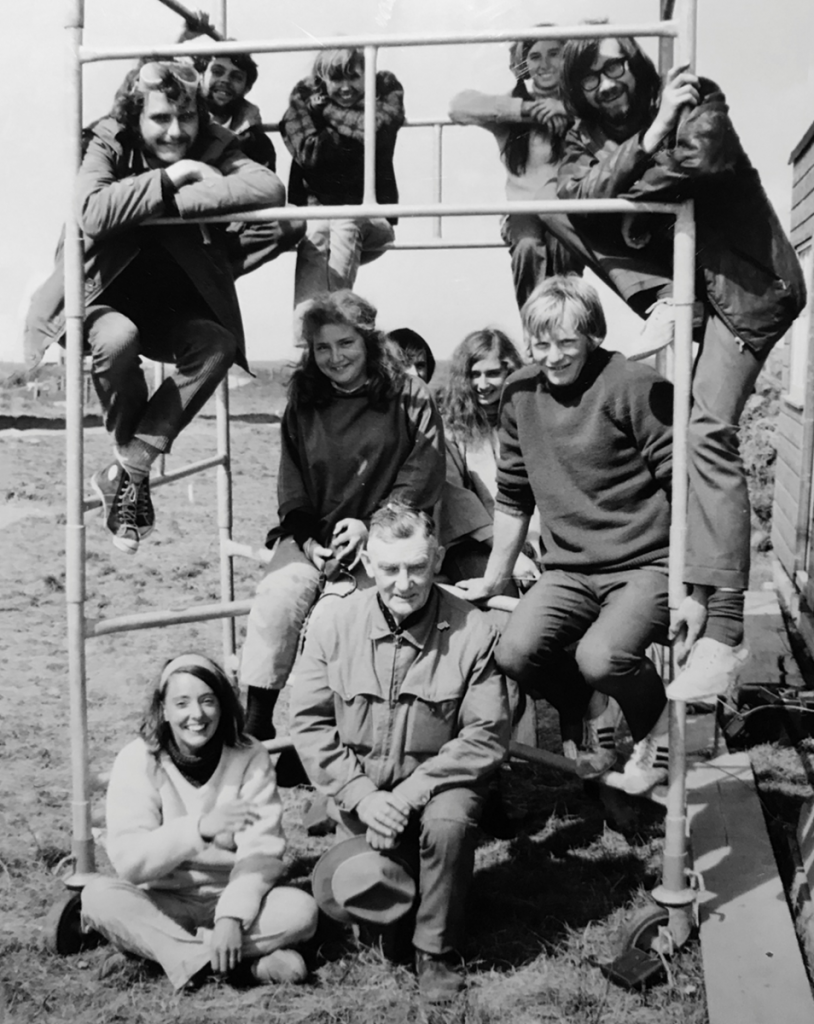
Figure one: The excavation team on the photographic tower at Buckquoy, 1970: including Ian Ralston top left and Ian Shepherd top right, Alexandra Shepherd in the centre with Isla MacInnes visible over her shoulder and John Adamson to her left, front row Anna with our Dutch volunteer, Ari Schermer.
After such a good introduction to Orkney, I was delighted to be offered an excavation of my own in Birsay, this time of a long low mound on the Point of Buckquoy, by the Department of the Environment (a precursor to today’s Historic Environment Scotland). I had only recently finished my PhD in 1970 and Buckquoy was effectively the start of my freelance career. This was a rescue excavation, prompted by the coastal erosion which was eating away at the mound and by the damage caused by traffic along the track which passed over the mound and led to the end of the Point. The mound overlooked Birsay Bay with the great cliffs of Marwick Head to the south and the tidal island of the Brough of Birsay to the north. Standing on the rocky shore below, looking up at the eroding mound, one could see a section through the site, with layers of paving and stumps of walls, and it was clearly going to be a domestic site. A great friend, Isla MacInnes, agreed to act as assistant director, and we spent a total of ten weeks digging there, over the summers of 1970 and 1971.
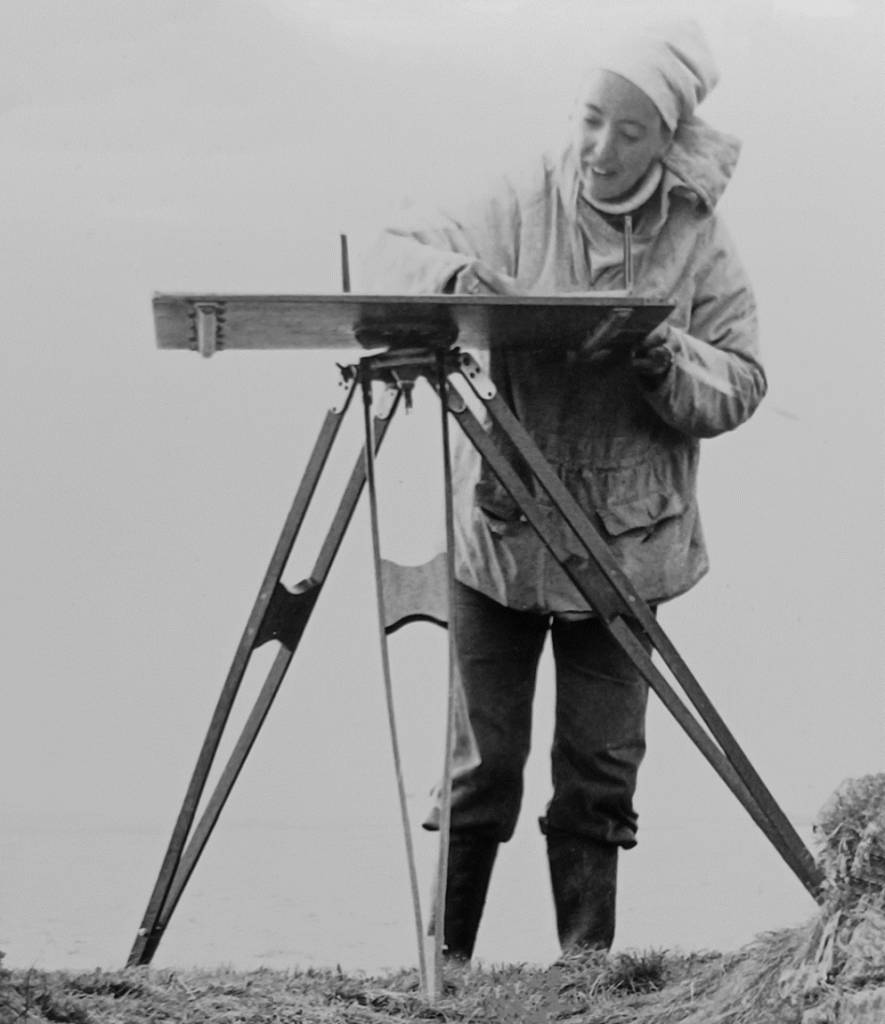
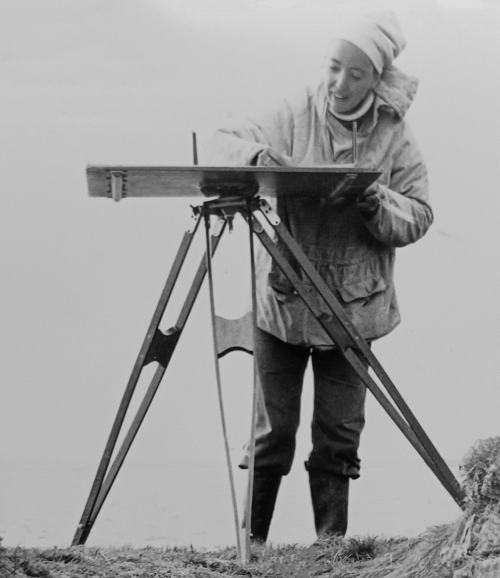
Figure two: Anna drawing at the plane-table, Knap of Howar 1973.
We were fortunate in our excavation team of students, some of whom went on to become leading figures in archaeology, including Ian Ralston, who became Abercromby Professor of Archaeology at Edinburgh, Ian Shepherd who became the regional archaeologist for Grampian, Alexandra (Lekky) Tuckwell (later Shepherd as she and Ian were to marry in 1976) who became a multi-talented freelance archaeologist, and Arthur MacGregor who became a senior curator in the Ashmolean Museum in Oxford. And we were lucky enough to have John Drever and the DOE Orkney squad as back up when we needed practical help. An unexpected bonus was the appearance on site one day of James Yorston, who had dug with his father for Professor Gordon Childe in Rousay in the 1940s. Jimmy also visited us when we were digging in Papa Westray three years later.
When we took off the turf at Buckquoy, we were instantly faced with the remains of a Viking-Age grave of the mid-tenth century, sadly damaged by ploughing. Beneath were the foundations of six consecutive buildings, starting with cellular houses which were replaced by rectangular structures. The finds were mostly early medieval in date, and the early cellular buildings could be assigned to the Picts on the basis of an ogham-inscribed spindle-whorl and an exquisitely painted pebble.
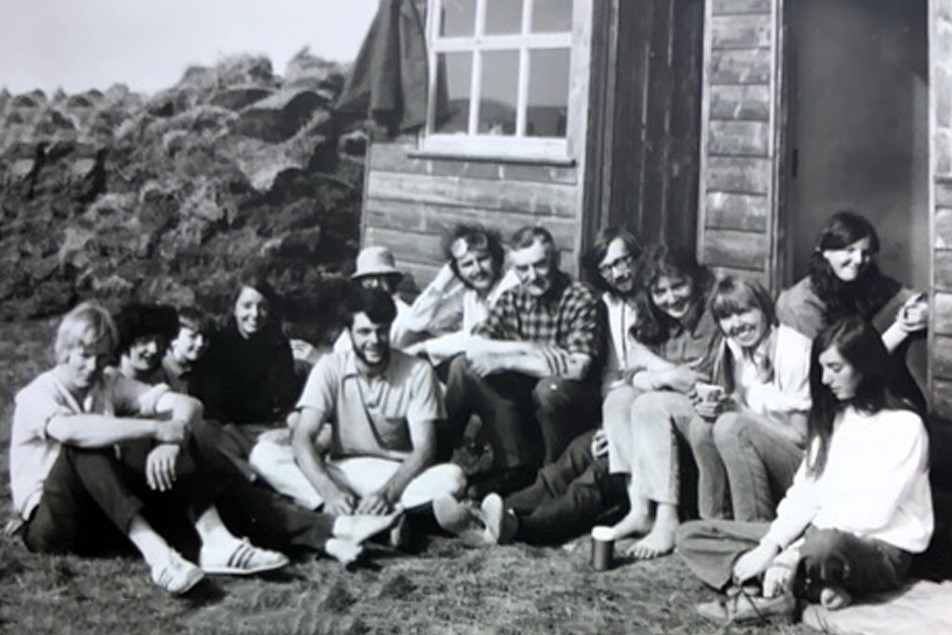
Figure three: The excavation team at Buckquoy. 1970: including from the left, John Adamson, fourth along Anna beside Isla MacInnes in a white hat, on her left Ian Ralston, our Dutch volunteer Ari Schermer, then Ian and Alexandra Shepherd.
We had no facilities on site for washing finds and it was not until I was back home in Edinburgh that the spindle whorl was cleaned. It was nicely shaped but otherwise pretty standard – but as I washed off the dirt the ogham inscription appeared, truly one of the most memorable moments of my life! Later on, Katherine Forsyth managed to translate the inscription as ‘A blessing on the soul of L’ (someone whose name began with L), and Sheila Fleet in Kirkwall based a range of beautiful jewellery on the whorl. Those two finds, the ogham whorl, and the painted pebble, meant that Buckquoy was the first Pictish settlement to be identified with certainty.
The change to rectangular buildings led me to argue that the farm had been taken over by Norsemen, and the fact that the incomers used mostly native artefacts seemed to suggest that the take-over was relatively peaceful. This argument became highly controversial and was hotly debated for some years. Colleen Batey and James Graham-Campbell sounded a note of caution in their 1998 book, Vikings in Scotland, where they suggested that my earliest Norse building was in fact a ‘modified Pictish building’. They were right, because radiocarbon dates obtained by Gordon Noble of the University of Aberdeen in the last few years have demonstrated that all the Buckquoy rectangular buildings belong to the eighth century and are definitely Pictish (radiocarbon dating was still too imprecise in the 1970s to attempt to use in the early medieval period). The only Viking contribution was the grave dug into the collapsed ruins of the Pictish farm in the second half of the tenth century.
Returning to Orkney in the summers of 1972 and 1973, I was fortunate enough to work with David Clarke on his research-based excavations at Skara Brae – an amazing experience to be closely involved with such an iconic site. At the close of the 1973 season there, I went out to Papa Westray to begin the second of my own excavations. Again, commissioned by the Department of the Environment, this involved a guardianship site known as Knap of Howar, where two stone-built and remarkably well-preserved houses stood in the sand dunes above the shore on the west coast of the island. They had been excavated in the early 1930s by William Traill of Holland House and William Kirkness, art teacher at Stromness Academy, and a sea wall was built to protect them when the site was taken into state guardianship in 1937. By the 1970s the walls of the houses had begun to collapse, and fresh excavation was needed before repair work could be done. The landowner was then John Rendall of Holland, who was honoured with an MBE for his care and stewardship of Knap of Howar over many years, and who was immensely helpful during our excavations in 1973 and 1975.
Paul Johnstone, executive producer of the archaeological series ‘Chronicle’ on BBC2, was interested in making a film about Knap, and we knew that one of the original excavators, William Kirkness, had himself made a film about the site. Paul and I went to visit him in his Edinburgh home, and he kindly allowed the BBC to make a copy of his film, which was silent but unusually for the time in 16mm format. It was fascinating to see, but not as helpful as I had hoped because it was shot after the end of the excavation. But he had also taken many photographs of the excavation in progress, which were indeed very helpful in our new excavations (these are in the Historic Environment Scotland archive in Edinburgh).
Several friends who had worked at Buckquoy were able to join me in Papa Westray: assistant director and site photographer was Ian Shepherd, and again Alexandra Tuckwell and Isla McInnes were part of the team. Most of us arrived by sea from Kirkwall, and others by air – the last leg of the flight from Kirkwall came from Westray, and sometimes the return flight passed low over our heads as we worked, especially when there was fog. There was a gap of a year between the two seasons at Knap, because Graham and I had a son that summer, Matt (who in time would become the archaeologist for Forestry Commission Scotland). Graham had begun to excavate the Stones of Stenness the previous year, and Ian and Lekky joined him for his second season in 1974, Ian as Assistant Director and Lekky painstakingly making sense of the central square stone setting.
Returning to Knap of Howar, the early excavations had not produced any real dating evidence, and the houses were thought perhaps to be Iron Age in date, although William Traill was convinced that they were earlier. The way in which both buildings were subdivided by upright slabs made me wonder whether they might be contemporary with neolithic stalled cairns, where the internal space is similarly divided into compartments for burials by upright slabs. This idea was confirmed after a few days of digging when we found sherds of carinated pottery bowls known as Unstan Ware, and again after the excavation when radiocarbon dates from animal bones showed that the houses had been occupied between about 3600 BC and 3100 BC. They were indeed contemporary with stalled burial cairns. Until then, we had only Skara Brae in west mainland and Rinyo in Rousay to show us what neolithic houses looked like in Orkney, and they were quite different: square internally with a central square hearth and cells built into the walls. If Knap was a croft inhabited by the users of Unstan Ware, they would be burying their dead in stalled cairns, of which the nearest known example is at the north of the tiny island of Holm of Papa Westray off the east coast of the main island.
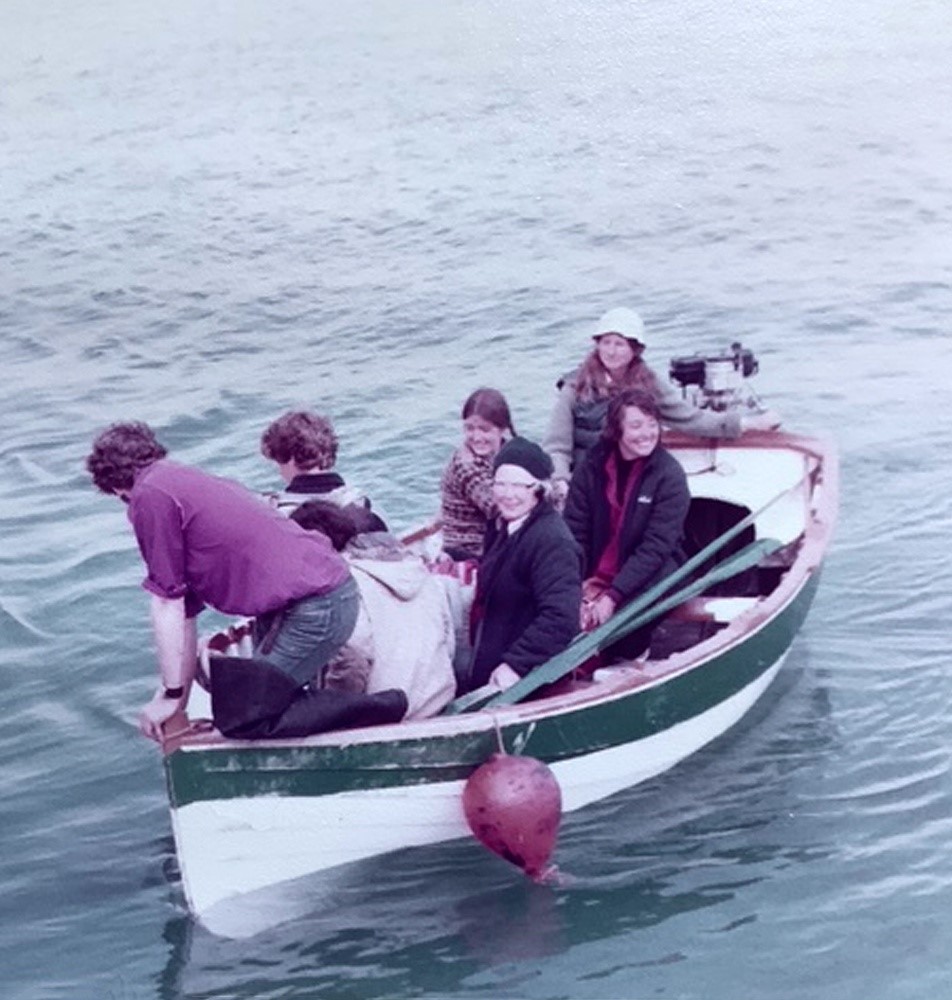
Figure four: On the boat to the Holm: Jocelyn Rendall at the tiller, with Anna in front of her and Jean Comrie in front of Anna, and Neil Rendall at the prow.
This was to be my next excavation, this time purely for research, for I hoped to find evidence of use of the tomb at the same time as Knap of Howar was flourishing. The site had been partially excavated in 1854, a two-day dig that had opened up the first three burial compartments but missed the fourth compartment and the entrance passage. With the consent of the landowners, John and Annie-Jean Rendall, and scheduled monument consent from the Department of the Environment, we excavated over two seasons in 1982 and 1983. In neolithic times the Holm was not an island but a promontory, accessible on foot, but we were dependent on the kind efforts of Neil Rendall, John, and Annie-Jean’s son, to take us across by boat and fetch us back at the end of the day. This aspect also affected the size of the team, for the boat could take no more than nine people. Jocelyn Grigg joined us for both seasons and subsequently married Neil Rendall and returned to Papay for good, writing a number of books about Orcadian history.
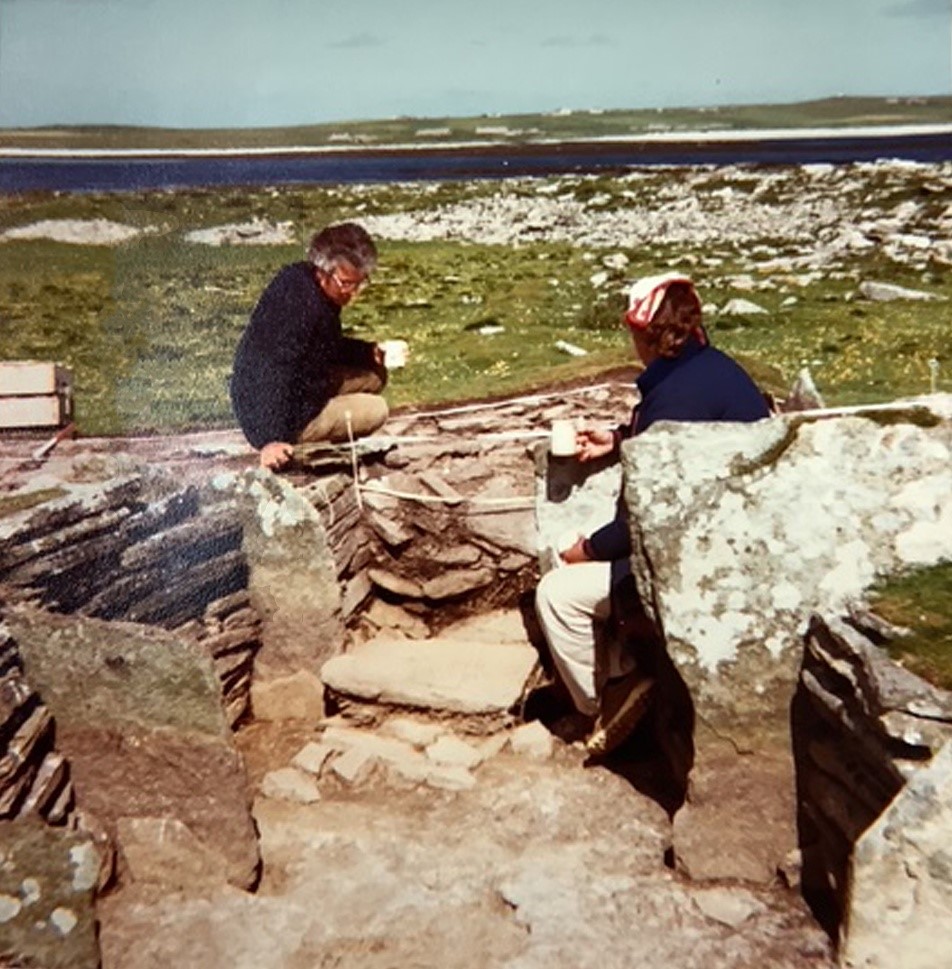
Figure five: Graham and Anna discussing the end-cell at Holm of Papa Westray North cairn, 1982.
I remember particularly that we had to be very careful walking about the island because there were eider duck nests hidden in the long grass. We were able to excavate the whole of the inside of the chamber and entrance passage as well as areas outside at both ends of the rectangular cairn. One of the unexpected outcomes was the discovery that the fourth compartment was in fact an earlier round cell within its own small cairn, which had been incorporated into the stalled cairn. Another was evidence that sheep used the chamber for lambing even while it was still in use for burials, which means that the entrance passage was not closed in any way. Otters lived in it too, leaving fish bones in their spraints. Radiocarbon dates from human and animal bones showed that the tomb was used between about 3520 and 3360 BC, supporting the idea that it was contemporary with Knap of Howar.
Mission accomplished – but only with the support of Alison Sheridan of National Museums Scotland during post-excavation work. I had under-estimated the problems of dealing with the faunal material produced by a privately funded excavation, from finding the right specialists to paying for the work, and this is why the final report did not appear until 2009. Alison is of course a neolithic specialist herself and she was able to interest scholars working on similar material in the Museum in the potential of what we had found at Holm of Papa Westray North. Once I had the specialists, I could apply for grants to pay for their work.
The results of both Papay excavations helped to nuance the discussion of the relationship between the communities who built stalled cairns and Knap of Howar type houses and used Unstan ware pottery, and those who built Maeshowe-type chambered tombs and Skara Brae-type houses and used Grooved Ware. For example, when the Holm tomb was finally sealed after the last burial, it was done by people using Grooved Ware, perhaps those who built the huge Maeshowe-type cairn at the south end of the island.
It was a great privilege to excavate in Orkney, where sites are often so well preserved, and the 70s especially were a great time to be there, when you couldn’t walk down Kirkwall’s main street without meeting at least one archaeologist from another dig. On our days off, we used to take the team to see Orkney’s famous and less famous monuments, the latter including a boat trip to Eynhallow, and to see other excavations, such as Sigrid Kaland’s dig at Westness and Colin Renfrew’s dig at Quanterness. For me, excavating two such closely associated sites in Papa Westray was a unique opportunity to investigate prehistoric life and death among an island community on the fringe of neolithic Europe.
Anna Ritchie, 2024